
Other Realms

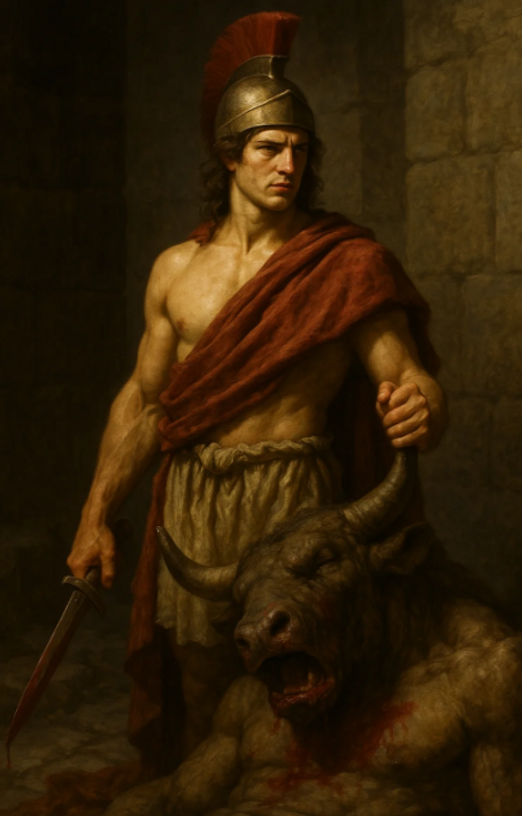
Theseus
Prince of Athens, Slayer of the Minotaur
The tale of Theseus begins with mystery and duality. His mother, Aethra, daughter of King Pittheus of Troezen, was visited by both Aegeus, the mortal king of Athens, and Poseidon, god of the sea, on the same night. As a result, Theseus was said to be both mortal and divine, a child of fate born from land and sea.
Before returning to Athens, Aegeus hid a sword and sandals beneath a great stone, instructing Aethra that when their son was strong enough to lift it, he should take the items and claim his birthright in Athens.
Years later, Theseus accomplished the feat, proving his worthiness. But instead of sailing safely to Athens, he chose the dangerous land route, seeking to prove his heroism by clearing the road of villains and monsters.
Like Heracles, Theseus performed six legendary labors on his way to Athens, each one symbolizing a battle against chaos, lawlessness, and predatory power:
Periphetes, the club-wielding bandit – Defeated using cunning and strength.
Sinis, who tore victims apart with bent pine trees – Outwitted and slain.
The Crommyonian Sow, a monstrous wild pig – Killed in defense of local villagers.
Sciron, who kicked travelers into a sea monster’s jaws – Cast into the sea himself.
Cercyon, a brute wrestler – Defeated through skill.
Procrustes, who tortured victims to fit his iron bed – Given his own punishment.
Each labor reflected not only physical strength but moral courage, making Theseus a civilizing hero, one who tamed the wilds for the good of the people.
Upon reaching Athens, Theseus was not welcomed with open arms. Medea, the sorceress wife of Aegeus, saw him as a threat and plotted to poison him. At a banquet, just as Theseus was about to drink the poisoned wine, Aegeus recognized the sword his son carried—the one from beneath the stone—and knocked the cup from his hand.
Reunited with his father, Theseus was declared the rightful heir to the Athenian throne.
Athens, at that time, lived under a terrible burden: as punishment for the death of King Minos’s son Androgeus, the city was forced to send 14 young Athenians (seven boys and seven girls) to Crete every nine years, where they were fed to the Minotaur—a monstrous hybrid of man and bull, imprisoned within the Labyrinth.
Theseus volunteered to go, determined to slay the beast and end the suffering of his people.
Upon arriving in Crete, Theseus met Ariadne, daughter of King Minos. Struck by love (or divine will), she chose to help him. She gave Theseus a ball of enchanted thread, taught to her by Daedalus, the designer of the Labyrinth.
Theseus tied one end at the entrance and ventured into the dark, winding maze. There, he faced the Minotaur, and after a fierce struggle, killed the beast with his bare hands or a sword, depending on the version.
Using the thread, he retraced his steps and led the other Athenians to safety, escaping with Ariadne across the sea.
On the journey home, Theseus abandoned Ariadne on the island of Naxos. Some say he did so cruelly; others claim it was fate, or the will of the gods, as Dionysus desired her for himself.
Worse still, Theseus had promised his father that if he survived, he would raise white sails. But in grief or distraction, he forgot—and as his ship approached Athens with black sails, Aegeus, believing his son dead, threw himself from a cliff into the sea, which was ever after called the Aegean Sea.
Theseus’s later years were marked by hubris and misfortune. Alongside his friend Pirithous, he attempted to abduct Persephone from the Underworld—a folly that angered Hades. Theseus was trapped in the Underworld, only rescued years later by Heracles.
His reign in Athens weakened. The people grew restless. Eventually, he was exiled and fled to the island of Skyros, where its king betrayed and killed him, pushing him off a cliff.
Theseus symbolizes the journey into darkness to confront the beast within—the hero’s journey through fear, confusion, and moral trial.
“Wherever there is a path, it was once a labyrinth. And wherever there is a hero, a beast once stood in his way.”
